Wednesday, April 8, 2026

Thank You for Smoking...or not


In the film Thank You for Smoking, Nick Naylor’s job was to justify the use of tobacco and turn its harmful effects into something positive by using numerous tactics and defending the tobacco industry.

I think that personal morals are sometimes challenged when you enter an industry such as the SIN industry, where the sole purpose is to sell goods or services commonly understood to be unethical, immoral, and socially detrimental, such as tobacco, alcohol, gambling, adult entertainment, and weapons.

Yet, the individuals who are a part of the SIN industry not only have to deal with their own moral compasses, they also have to face the sound of the public, whether that's scrutiny from individuals, reputational damage, or social stigmas placed upon them; it is simply a part of the professional territory that they work in.

It is pretty hard for someone with strong beliefs in something as big as this to defend one who makes a living off of defending and representing something that simply cannot be defended or excused, solely because it is morally unacceptable. 

mm 

On the other hand, morals tend to become outweighed by the mention of money. If one were offered a starting pay of $200,000, morals and social scrutiny would be placed on the back burner, and someone who does not consider what society thinks would thrive in this position and would thrive in life with the large paycheck. 

Personally, I am not one to care much about what outsiders have to say, but I do cherish the perception that my loved ones have of me, along with the self-satisfaction I feel for my beliefs and actions, so I could not take on a job like Nick Naylor’s and actively be an enabler and have to deal with the possibility of my actions fueling someone's addiction or possibly having a hand in someone creating an addiction due to the products that I am endorsing, not even for one million dollars. 

                   
                                            7 Deady Sins of Advertising image insert

Advertising for these products, such as being placed in movies, on billboards, or even on the internet, is not restricted and is unlikely to become outlawed because it is considered and protected as "commercial speech”. As long as the speech in the ad is not false, misleading, or deceptive, then it is protected and able to be shared with others. 

These products, though morally and socially unacceptable, will never fully be banned and deemed illegal because it is much more dangerous to try to get rid of the products than to ban them. This would lead to unregulated products, the acts of using and/or selling these products illegally, and numerous other dangers. 
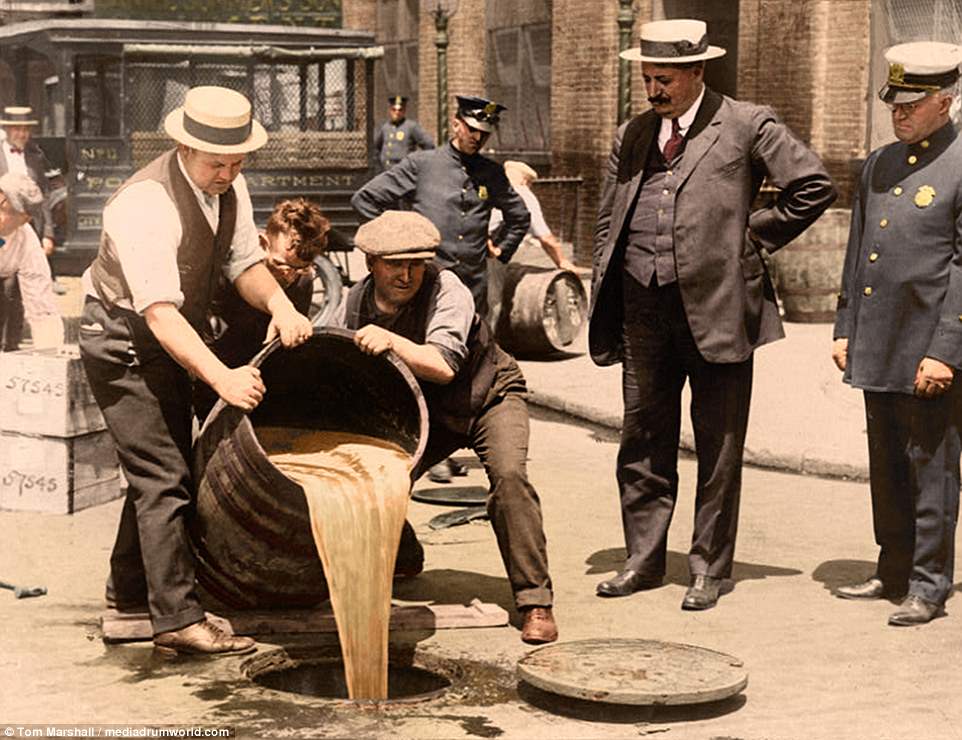
                                                From 1920 to 1933, the US government issued a nationwide constitutional ban on the production, importation, transportation and sale of alcoholic beverages. Now, British colorization expert Tom Marshall, has taken originally black-and-white photos from the era and brought them back to life in full color. Pictured above, New York City Deputy Police Commissioner John A. Leach, right, watching agents pour liquor into sewer following a raid during the height of prohibition

On January 17th, 1920, the 18th Amendment was put into effect. This amendment prohibited “the manufacture, sale, or transportation of intoxicating liquors”, leading to the rise of speakeasies; these were hidden establishments requiring a password, so one could access the social hub that sold alcoholic beverages and provided individuals with live music and dancing.

These establishments were dangerous, and thousands of people died from consuming the unregulated alcohol they provided. Many speakeasies had alcohol that was made from inexperienced bootleggers, who included industrial alcohol, which is made for use in fuel and medical supplies, in the drinks, which led to the high risks of being blinded, poisoned, or killed.

The government essentially forced these companies to make industrial alcohol undrinkable, and this, along with the terrible and low-quality products that the bootleggers used, created a recipe for disaster.
This is one of the many reasons the SIN industry is a necessary evil and will continue to thrive as time passes, because someone must take the job of defending the indefensible. 


Thursday, April 2, 2026

EOTO: Carrier Pigeons


The United States Military has a track record for using animals in combat and supporting roles. These animals were usually used for transportation and communication when all other solutions were nearly impossible. 

One of the lesser-known but very fascinating chapters in military and communication history is the use of carrier pigeons, more properly called homing pigeons.

The idea and concept of the Pigeons seems a bit confusing and unbelievable, but according to the National Museum of American History, these pigeons had a success rate of 95%. And due to their importance during wartime, approximately 56,000 pigeons were trained. 

From 1917 to 1957, the U.S. The Army Signal Corps maintained systems of communication that relied on messenger pigeons. These birds served in World War I, World War II, and the Korean War, providing a simple and reliable line of one-way communication when other methods were unavailable or too risky.

World War II was the peak of the use of these carrier pigeons; they saved many lives over the span of the war. And of these birds, thirty-two of them received medals for their service and hard work in the war. 

One bird, most of us have heard of, whether we realize it or not, is G.I. Joe. This pigeon flew twenty miles in twenty minutes, carrying a message that told soldiers to cancel the bombing mission just as the bombers were getting ready to take off. Joe not only saved the lives of many soldiers but also those of civilians as well.   

Homing pigeons are the result of selective breeding carried out over several hundred years. Breeders selected birds based on performance, their endurance, speed, and an uncanny ability to find their way home across unfamiliar terrain. But breeding alone isn’t enough. Regardless of bloodline, pigeons need regular training to build fitness and navigational skill. Typically, a young pigeon begins training two to three months after hatching, gradually flying longer distances until it is ready for operational duty.

In service, most homing pigeons routinely covered distances over twenty miles. Many could fly between fifty and one hundred miles on a single trip. Exceptional birds were capable of far greater trips; some recorded flights exceeded eleven hundred miles. Speed was also impressive: peak speeds could reach about sixty miles per hour, while average cruising speed was roughly forty miles per hour.

Operational use required a simple but crucial logistical step: to send a message from a forward location, someone first had to transport the pigeons to that location. When a message needed to go back to base, the pigeon would be released and navigate home. Because this system was essentially one-way, planning and coordination were essential to ensure pigeons were placed where they could be useful.

Beyond text messages, these birds have carried surprising payloads. In addition to small message capsules, pigeons have been used to carry tiny cameras, USB drives in modern tests, blood samples, and even small quantities of medicines, which were usually over short distances and light loads, sometimes up to about fifteen feet in weight-equivalent terms for tiny items that were strapped onto the birds.

Carrier pigeons remind us that sometimes low-tech solutions can be highly effective. They combined biological adaptation, selective breeding, and disciplined training to deliver reliable communication under difficult and extreme circumstances. Even in an age of satellites and digital networks, their story highlights human innovation and cleverness in using the natural world to solve practical problems.


Thank You for Smoking...or not

                                           In the film Thank You for Smoking, Nick Naylor’s job was to justify the use of tobacco and turn...