Wednesday, April 8, 2026

Thank You for Smoking...or not


In the film Thank You for Smoking, Nick Naylor’s job was to justify the use of tobacco and turn its harmful effects into something positive by using numerous tactics and defending the tobacco industry.

I think that personal morals are sometimes challenged when you enter an industry such as the SIN industry, where the sole purpose is to sell goods or services commonly understood to be unethical, immoral, and socially detrimental, such as tobacco, alcohol, gambling, adult entertainment, and weapons.

Yet, the individuals who are a part of the SIN industry not only have to deal with their own moral compasses, they also have to face the sound of the public, whether that's scrutiny from individuals, reputational damage, or social stigmas placed upon them; it is simply a part of the professional territory that they work in.

It is pretty hard for someone with strong beliefs in something as big as this to defend one who makes a living off of defending and representing something that simply cannot be defended or excused, solely because it is morally unacceptable. 

mm 

On the other hand, morals tend to become outweighed by the mention of money. If one were offered a starting pay of $200,000, morals and social scrutiny would be placed on the back burner, and someone who does not consider what society thinks would thrive in this position and would thrive in life with the large paycheck. 

Personally, I am not one to care much about what outsiders have to say, but I do cherish the perception that my loved ones have of me, along with the self-satisfaction I feel for my beliefs and actions, so I could not take on a job like Nick Naylor’s and actively be an enabler and have to deal with the possibility of my actions fueling someone's addiction or possibly having a hand in someone creating an addiction due to the products that I am endorsing, not even for one million dollars. 

                   
                                            7 Deady Sins of Advertising image insert

Advertising for these products, such as being placed in movies, on billboards, or even on the internet, is not restricted and is unlikely to become outlawed because it is considered and protected as "commercial speech”. As long as the speech in the ad is not false, misleading, or deceptive, then it is protected and able to be shared with others. 

These products, though morally and socially unacceptable, will never fully be banned and deemed illegal because it is much more dangerous to try to get rid of the products than to ban them. This would lead to unregulated products, the acts of using and/or selling these products illegally, and numerous other dangers. 
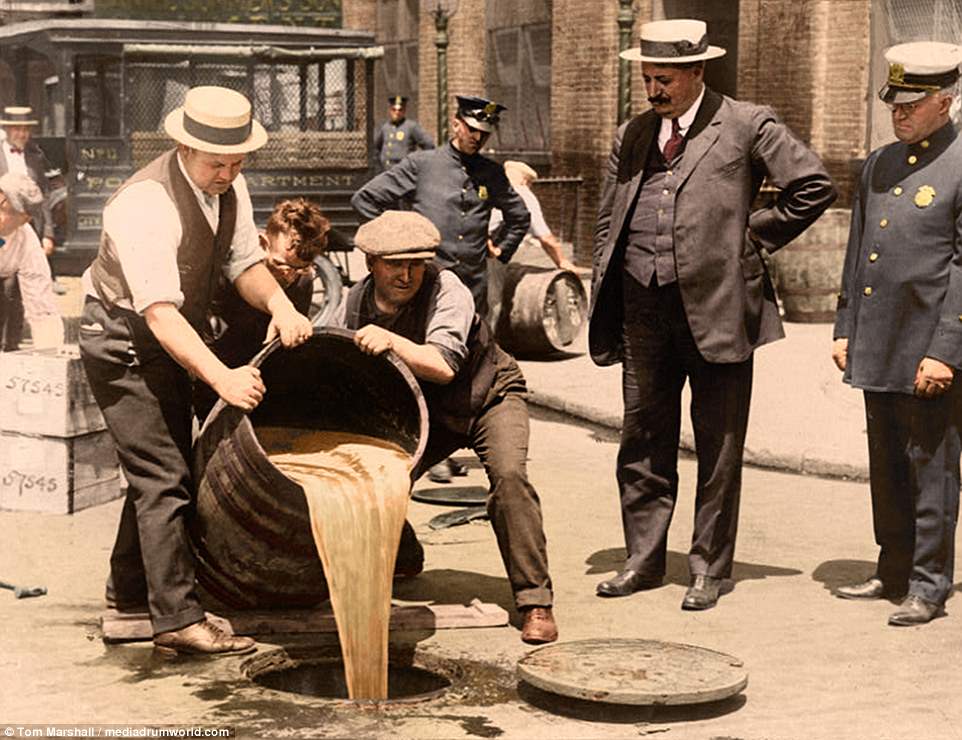
                                                From 1920 to 1933, the US government issued a nationwide constitutional ban on the production, importation, transportation and sale of alcoholic beverages. Now, British colorization expert Tom Marshall, has taken originally black-and-white photos from the era and brought them back to life in full color. Pictured above, New York City Deputy Police Commissioner John A. Leach, right, watching agents pour liquor into sewer following a raid during the height of prohibition

On January 17th, 1920, the 18th Amendment was put into effect. This amendment prohibited “the manufacture, sale, or transportation of intoxicating liquors”, leading to the rise of speakeasies; these were hidden establishments requiring a password, so one could access the social hub that sold alcoholic beverages and provided individuals with live music and dancing.

These establishments were dangerous, and thousands of people died from consuming the unregulated alcohol they provided. Many speakeasies had alcohol that was made from inexperienced bootleggers, who included industrial alcohol, which is made for use in fuel and medical supplies, in the drinks, which led to the high risks of being blinded, poisoned, or killed.

The government essentially forced these companies to make industrial alcohol undrinkable, and this, along with the terrible and low-quality products that the bootleggers used, created a recipe for disaster.
This is one of the many reasons the SIN industry is a necessary evil and will continue to thrive as time passes, because someone must take the job of defending the indefensible. 


Thursday, April 2, 2026

EOTO: Carrier Pigeons


The United States Military has a track record for using animals in combat and supporting roles. These animals were usually used for transportation and communication when all other solutions were nearly impossible. 

One of the lesser-known but very fascinating chapters in military and communication history is the use of carrier pigeons, more properly called homing pigeons.

The idea and concept of the Pigeons seems a bit confusing and unbelievable, but according to the National Museum of American History, these pigeons had a success rate of 95%. And due to their importance during wartime, approximately 56,000 pigeons were trained. 

From 1917 to 1957, the U.S. The Army Signal Corps maintained systems of communication that relied on messenger pigeons. These birds served in World War I, World War II, and the Korean War, providing a simple and reliable line of one-way communication when other methods were unavailable or too risky.

World War II was the peak of the use of these carrier pigeons; they saved many lives over the span of the war. And of these birds, thirty-two of them received medals for their service and hard work in the war. 

One bird, most of us have heard of, whether we realize it or not, is G.I. Joe. This pigeon flew twenty miles in twenty minutes, carrying a message that told soldiers to cancel the bombing mission just as the bombers were getting ready to take off. Joe not only saved the lives of many soldiers but also those of civilians as well.   

Homing pigeons are the result of selective breeding carried out over several hundred years. Breeders selected birds based on performance, their endurance, speed, and an uncanny ability to find their way home across unfamiliar terrain. But breeding alone isn’t enough. Regardless of bloodline, pigeons need regular training to build fitness and navigational skill. Typically, a young pigeon begins training two to three months after hatching, gradually flying longer distances until it is ready for operational duty.

In service, most homing pigeons routinely covered distances over twenty miles. Many could fly between fifty and one hundred miles on a single trip. Exceptional birds were capable of far greater trips; some recorded flights exceeded eleven hundred miles. Speed was also impressive: peak speeds could reach about sixty miles per hour, while average cruising speed was roughly forty miles per hour.

Operational use required a simple but crucial logistical step: to send a message from a forward location, someone first had to transport the pigeons to that location. When a message needed to go back to base, the pigeon would be released and navigate home. Because this system was essentially one-way, planning and coordination were essential to ensure pigeons were placed where they could be useful.

Beyond text messages, these birds have carried surprising payloads. In addition to small message capsules, pigeons have been used to carry tiny cameras, USB drives in modern tests, blood samples, and even small quantities of medicines, which were usually over short distances and light loads, sometimes up to about fifteen feet in weight-equivalent terms for tiny items that were strapped onto the birds.

Carrier pigeons remind us that sometimes low-tech solutions can be highly effective. They combined biological adaptation, selective breeding, and disciplined training to deliver reliable communication under difficult and extreme circumstances. Even in an age of satellites and digital networks, their story highlights human innovation and cleverness in using the natural world to solve practical problems.


Friday, February 20, 2026

Eight Values of Free Expression


When we talk about free expression, there are 8 values that we consider to be the core to how society functions. These eight values are: Marketplace of Ideas, Participation in Self-Government, Stable Change, Individual Self-Fulfillment, Checks on Governmental Power, Promoting Tolerance, Promoting Innovation, and Protecting Dissent.


The value that sticks out and resonates with me the most is the value of promoting tolerance. This theory has become a core value because it has been argued for decades that freedom of speech, especially through the practice of extending protection to hate speech, teaches us as a society to become more tolerant in all aspects of life. This theory thrives on the belief that the act of promoting expressive freedoms will also make the members of society more open to thoughts and ideas that they would normally be against. 


With hate speech being protected by the First Amendment, it is common for individuals to use forms of speech in public areas, giving the members of society the opportunity to comment on and/or act against the hate speech being said. After members of society act positively or negatively towards that hate speech, it then creates a social norm and provides everyone with a lesson or an understanding of the hate speech, why it was considered hate speech, and allows society to act accordingly in the present as well as the future. 


What immediately came to mind when I read the description of the promoting tolerance theory was the current cancel culture happening around the globe. At a time when social media presence, ignorance, and disrespect are all at an all-time high, there is a pot of conflict boiling. 


When an individual or a company says or does something that goes against societal norms or beliefs, then social media rips them to shreds, highlights what was wrong with what they said or did, and then proceeds to “cancel” them. Canceling in the form of calling out an individual or a group publicly for offensive behavior to hold them accountable for their actions and force them to face consequences. This is mostly done on social media and is frequently mistaken as cyberbullying.


I believe that this may be the most important value or theory of the eight, especially in a constantly evolving society. Allowing everyone to be tolerant in a world of complacency is best. A tolerant society is a healthy society because it allows everyone to create a positive environment, reduces conflict, and promotes innovation and mutual respect by embracing diverse lifestyles and perspectives. 


If it is not obvious, protecting dissent seems to be the value that is mostly in action today, especially heightened since 2020. This theory essentially states that you are protected by the First Amendment to disagree with the government and anyone else, for that matter, no matter how unpopular your opinions and disagreements may be. Social movements, peaceful protests, and other forms of activism have begun to become more popular and visible around the world. 


Ensuring the protection of dissent is also popular. For example, the NAACP has a Legal Defense Fund. This fund is set in place to protect protestors from violence, especially from police officials. The protection of this fund has ranged from the 1961 Freedom Riders to the 2020 Black Lives Matter (BLM) racial justice protestors, where over 125 separate incidents of police violence against protesters were reported across 40 states, in the span of 10 days.

Thursday, February 19, 2026

AI Brainstorm


After watching the PBS In the Age of AI documentary, I realized just how much Artificial Intelligence and the internet have begun to take over, and over time will eventually fully change the way the world is as we know it today. While both the internet and artificial intelligence both have positive effects, there are numerous negative effects. The creation of Artificial Intelligence was meant to create a way for humans to spend less time on routine tasks and spend more time doing things that they actually enjoy, being a tool used to enhance human life, not ruin it, which it seems to be on track to do.


Artificial Intelligence has been used and abused by many people around the world. The tool that was created to help is now taking over hundreds of thousands of jobs. When we think of machines taking jobs, we usually think of car manufacturing, assembly lines, or even phone operators. All of which are majority male-dominated roles.  


But one danger that not many people think of or talk about is the women-dominated jobs that are being replaced by artificial intelligence. Jobs such as cashiers, fast food workers, and the majority of customer-service-centered industry roles. These roles are single-handedly being taken over by Artificial Intelligence and technology.


I know that when I go to places like Walmart, I probably will not have any customer service interactions while there, and I will also have to shop for my own items, check myself out, and bag my own products. A job that was once completed by a cashier is now being completed by a consumer and technology. If we continue down this path, I am concerned that nobody will have jobs anymore, and more people will succumb to living paycheck-to-paycheck due to the decrease in job security and job demand. 


Thursday, February 5, 2026

Is Privacy Real?!


How would it make you feel if you found that someone knew every thought, purchase, and your daily routine? I'm sure you’d feel spooked, but what’s even more spooky is the fact that this is true- google amongst other platforms know more about you than you think.


 This article from Campaigns of The World helped me understand how much information one singular platform is collecting from me and others. When you think about all of this information multiplied by the number of apps and websites that you visit daily, the amount of “personal” information that is now public is large, and it slightly makes me feel unsafe to know that what I once thought was my personal information and data is not only mine anymore.


Growing up, we’re taught the basic internet safety, such as creating a strong password, not talking to strangers, and sharing personal information, and much more. But in reality, no matter the precautions we think that we are taking, it's not enough. Especially when individuals tend to use a private browser or incognito mode, they are more vulnerable, even though data is still being collected in reality.


But one danger that not many people think of or talk about is women-dominated jobs, such as cashiers, fast food workers, and the majority of customer-service-centered roles. These roles are single-handedly being taken over by Artificial Intelligence and technology.


I know that when I go to places like Walmart, I probably will not have any customer service interactions, and I will have to shop for my own items, check myself out, and bag my own products. A job that was once completed by a cashier is now being completed by a consumer and technology. If we continue down this path, I am concerned that nobody will have jobs anymore, and more people will succumb to living paycheck-to-paycheck. 

Wednesday, January 28, 2026

My Top 5 News Sources


In a world where technology is evolving and taking over almost all aspects of our lives, traditional methods of receiving news, such as physical newspapers, merchants, or reporters on horseback with a lamp yelling throughout the village, and radio stations like President Roosevelt's “fireside chats,” are no longer common. I, along with many of my peers and even our elders, rely heavily on technology and the modern-day internet and all of the resources that come along with it. Below are my top five new sources as a Gen-Z college student who does not get news most traditionally. 


The first way I most commonly get all of my news information is from Google Alerts, based on my frequent searches or any of the topics that I have marked “interested in” on the Google Chrome app, which tends to send me alerts and notifications directly to my phone 24/7. In addition, any breaking news that Google feels everyone should know also comes to the phone as an alert or notification. Although it is not the most traditional, it is very convenient and useful because it includes everything that I deem relevant or important. As a Sport Management Major, I have a strong passion for sports, particularly college basketball. So being able to receive live updates to my phone about the current Carolina men's basketball game is a lifesaver.  


My second source of news and information would be social media, which includes but is not limited to Instagram, TikTok, Facebook, and X (formerly known as Twitter). Each social media platform has different forms of outreach and appeals to various audiences. Social media tends to give me a quick rundown of the information in a much more interesting way than a newspaper would. Social media allows users to post instantly, so frequent updates are always necessary and helpful to have. Although I think social media is a good way to receive news, I am also aware of the fact that this news could lack evidence, could be biased, could be all around false, and so much more. So I always tend to put my own form of research into the quick news that I receive, but using the platforms as a stepping stone.


Growing up, I used to watch the 6 pm ABC11 news with my grandfather, so as I grew up and as the internet evolved more, I stopped watching the news on television in the traditional way and began to look up the news on their website. Whether this news channel is politically biased, I do not know, but I do know that this is one of the two news channels that I grew up watching, so I just continued to do so. I tend to do a quick scroll on the website now and then, but it is not my most frequented news source. 


Like previously mentioned, I used to watch the news with my grandad, and when I stopped, he did not. So if there is anything major in the news or something he feels like I should know, he would give me a call and update me on the current news and how it affects me. From weather updates, political updates, all the way to what is going on in the sports industry, my grandad does not fail to update me. His news is pretty accurate, but I still sometimes do my own research to fact-check him as well, and so I can tell him that I actually looked into it. 


Lastly, and this may come as a surprise to none, Professor Dean Smith is one of my current news sources. I come to class every Tuesday and Thursday and learn something new about what's going on in the world. As a journalist, you’re supposed to be a source who is unbiased, can play both sides when needed, and can give accurate, trustworthy news to the public. And these are all characteristics that Professor Smith emphasises and embodies, making him a great news source for me!


Thank You for Smoking...or not

                                           In the film Thank You for Smoking, Nick Naylor’s job was to justify the use of tobacco and turn...